This test method covers the determination of the relative peel resistance of adhesive bonds between one rigid adherend and one flexible adherend when tested under specified conditions of preparation and testing. Usually the thickness of the sheets is shown in material specification. If the thickness is not stated, the flexible adhering should be 0.63 mm (0.025 in.) thick and rigid…
02
This fixture is designed to maintain a constant peel angle of 90 degrees, as an upper sheet is peeled from the rest of a honeycomb panel. Using this fixture can be tested other structures consisting of a flexible face sheet and a more rigid substrate. Are recommended face sheet thicknesses less than 0.010”. The NASA test fixture pulls the face…
This test method describes a procedure and fixture used to determine shear strengths of adhesives used to bond materials with moduli higher than the modulus of the adhesive. The size and shape of the specimens are variable within the physical restraints of the fixture.Two blocks of specific sizes are bonded together. A typical test specimen consists of a 1” x…
This test method can be used to determine the adhesive bond shear strength between other adherends as well. The basic testing principle is similar to that of the ASTM D 4501 Block-Shear Test Method. The standard specimen consists of two blocks, each 1.75” high and 2” wide, bonded together with a ¼” vertical stagger (a ¼” step between blocks in…
This testing device is used to determine the shear strength of the welds of welded wire fabric.As it regards the two standards ASTM A 497 and ASTM A 185, there are no substantial differences, for this reason they use the same test fixture. From the wire fabric, is cut a weld junction , with the transverse wire extending approximately 1”…
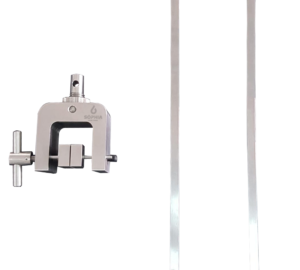
ASTM D1781 Testing Fixture This procedure is useful for the determination of the peel resistance of adhesive bonds adhering a relatively flexible and adhering rigid; and the relatively flexible coating of a sandwich structure and its nucleus, to the test under the specified conditions. This standard does not purport to address all of the safety concerns, if any, associated with…